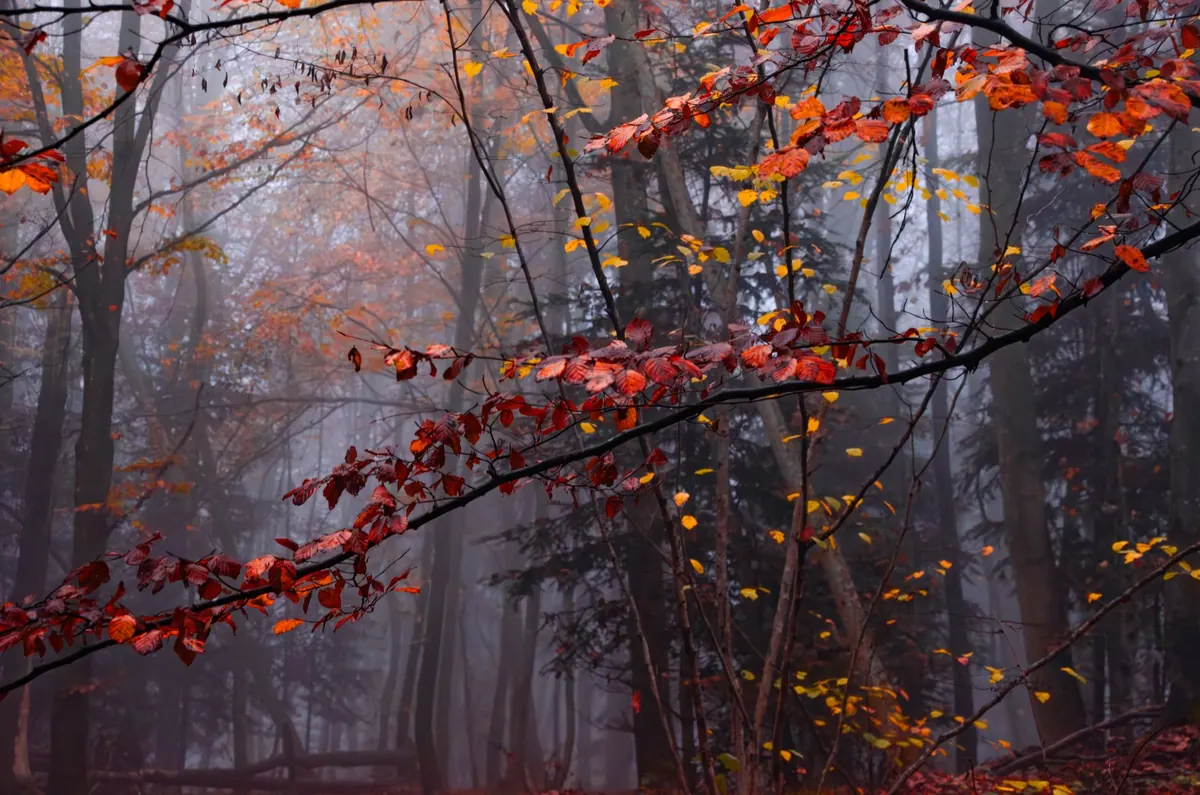
Autumn in a deciduous wood rarely arrives all at once. One beech turns copper while the oak beside it is still green. A single misty morning can make a familiar lane look like somewhere you have never walked, and the next day the same view is flat and ordinary. That unevenness is the appeal, and the difficulty. You cannot book autumn colour the way you book a hotel room. You read the wood, watch the weather, and turn out early on mornings that look unpromising on paper. Get those three roughly right and woodland photography stops feeling like a lottery.
Walk your local woods in mid-September with no camera at all. Note which trees turn first, where the low sun lands at eight in the morning, and which paths face east. Come back a fortnight later and you will already know where to stand.
Species matter more than most photographers realise. Birch and field maple turn early and go bright yellow. Oak holds its leaves late and shifts to a duller russet. Beech and sweet chestnut are the ones that give you warm copper and gold, often hanging on into November before the canopy opens up. Ash drops quickly and stands bare while everything around it is still full. Knowing which tree you are standing under tells you whether to return next week or next month.
Colour does not live only above head height, either. Wet leaf litter, mossy stumps, ferns turning bronze, bracken going rust-coloured along the woodland edge — all of it can carry a picture when the canopy is a mess or the wind is up. Small scenes are often the strongest ones in autumn, and they are far easier to photograph well.
Mist is mostly physics, which means it is partly predictable. On a clear, calm night after a damp day, the ground cools quickly and the air above it reaches dew point. Mist forms first in hollows, along streams and over wet fields, then spreads. It usually thickens towards sunrise and burns off within an hour or two once the sun clears the treeline. Any real wind tears it apart.
So the recipe is: recent rain, a clear night, light wind, and being in position before the sun reaches the wood. Valley bottoms and ground beside water are your best bets. Check the forecast the night before and look at wind speed as closely as temperature. If it promises a stiff breeze, the mist will not survive, however cold it feels.
Rain has its own value. Wet bark goes almost black, leaves hold saturated colour, and puddles double the canopy. Flat overcast light is genuinely useful for close-up work on leaves and fungi, where direct sun creates harsh highlights and hard shadows. Save the bright mornings for backlight and for scenes where you want the mist to glow.
A wood in autumn is chaos: a thousand competing shapes, none of them arranged for your convenience. The instinct is to photograph all of it. Resist that. Decide on one subject — a single trunk, a fallen log, a curve of branches — and build the frame around it.
A longer lens is the most useful tool you have. Something around 100–200mm compresses the scene and lets you pick out a single backlit spray of leaves against a dark trunk, or a line of trees fading into the distance. It also removes the messy foreground that so often spoils a wide view. Use a wide lens only when you have a strong foreground to anchor it: a path, a stream, a fallen branch leading the eye in.
Mist is the most efficient clutter remover available. It strips detail from everything beyond twenty metres and turns the wood into layers of shape and tone, which is exactly what a busy scene needs. Look for subjects at different distances — a near trunk, a mid-ground group, a faint outline behind — and let the fog sort them into order. Backlight does something similar: find leaves between you and the sun and expose for the brightest of them, keeping the trunk behind them dark.
Look up as often as you look down, and get low when a scene is not working. A trunk-level view through bracken or a drift of fallen leaves is a different picture from the one everybody else takes from the path.
Autumn images usually fail in one of two ways: highlights blown out in the brightest leaves, or colour pushed so far it looks like a preset. Both are straightforward to avoid.
Shoot raw where you can, and trust the histogram rather than the screen. Yellow and orange leaves are bright and clip easily, and the red channel often goes first, which is why over-exposed foliage turns a flat, pale orange. Expose for the brightest leaves and let the shadows fall where they may; there is plenty of detail to recover in the dark areas of a woodland frame.
Mist needs the opposite attention. A camera meters for mid-grey, so a scene that is mostly bright fog will come out darker and greyer than it felt at the time. Add a third of a stop to a full stop of positive exposure compensation and check the histogram again. Keep the mist bright and the trunks dark, and the picture will hold together.
For white balance, daylight is a sensible default; the shade or cloudy preset warms things up if the wood feels too blue. A polarising filter cuts glare from wet leaves and deepens colour nicely, but be careful with very wide lenses and blue sky, where it can darken one corner unevenly.
Finally, watch the wind. Either freeze the leaves at a fast shutter speed or commit to a long exposure and let them blur into streaks. Middling speeds tend to look like an accident. For everything else, f/8 to f/11, a tripod and a low ISO will give you clean, sharp files in the low light of early morning.
One visit is rarely enough. Pick two or three woods you can reach easily and go back four or five times across the season, noting which tree was at its best and which morning gave you the mist. Review the histogram, not just the picture, before deciding what to change next time. Very often the second visit is better than the first, simply because you already know where to stand. And when the leaves are down and the first frosts arrive, keep going: bare branches, hard light and frozen puddles make a quieter, starker kind of woodland photograph that most people miss because they put the camera away too early.
Photo: Adrian Limani / Pexels
A practical packing guide for nature photographers heading into the British outdoors, covering cameras, lenses, rain...
How to find, time and photograph Lake District fog — accessible viewpoints from Buttermere to Tarn Hows, exposure...
A practical guide to photographing Britain's spring wildflowers: reading the bluebell season, working with soft...

Exploring misty landscapes and quiet natural places.
